- Web app
- Internal tool
- Automation
- Data & BI
ProspectAtlasB2B prospecting on four official registers
My own prospecting tool: companies from Belgium, France, Switzerland and Spain brought together in one dashboard.

Launch film · English voice-over and captions · 0:59
The film, in text
To offer my services, I first have to find the right companies. Four countries to cover: Belgium, France, Switzerland and Spain.
By hand, that means hours of repetitive research, one company at a time. So I designed and built ProspectAtlas, my own prospecting tool.
It starts from official company registers, country by country.
It brings everything into one format, whatever the country or the language.
It completes each record: activity, public contact details, online presence.
It checks whether the company really has a website: a social profile or a directory listing doesn’t count.
Then it qualifies each company, and sets aside the ones that aren’t relevant.
Everything lands in one dashboard, running locally on my PC.
All that’s left for me is a personalised approach: a website, an automation, a dashboard or an iOS app. ProspectAtlas: collect, normalise, enrich, qualify.
The tool, step by step
7 steps, each on one of the tool’s screens. Interface rebuilt for the film, with invented companies and figures.
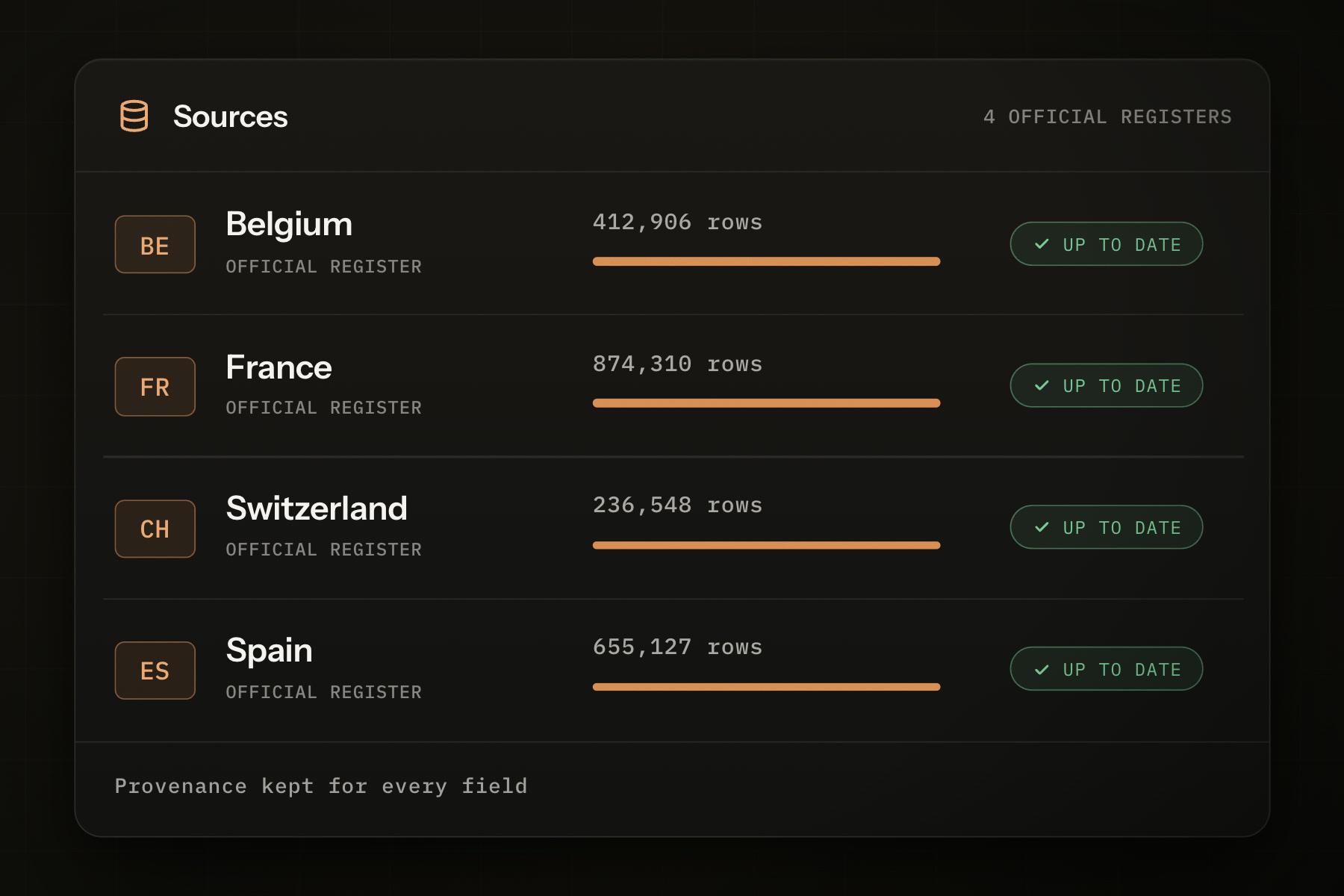
ProspectAtlas starts from official company registers, one source per country, and keeps the provenance of every field.
- Four countries: Belgium, France, Switzerland, Spain
- One official register per country
- The provenance of every field is kept
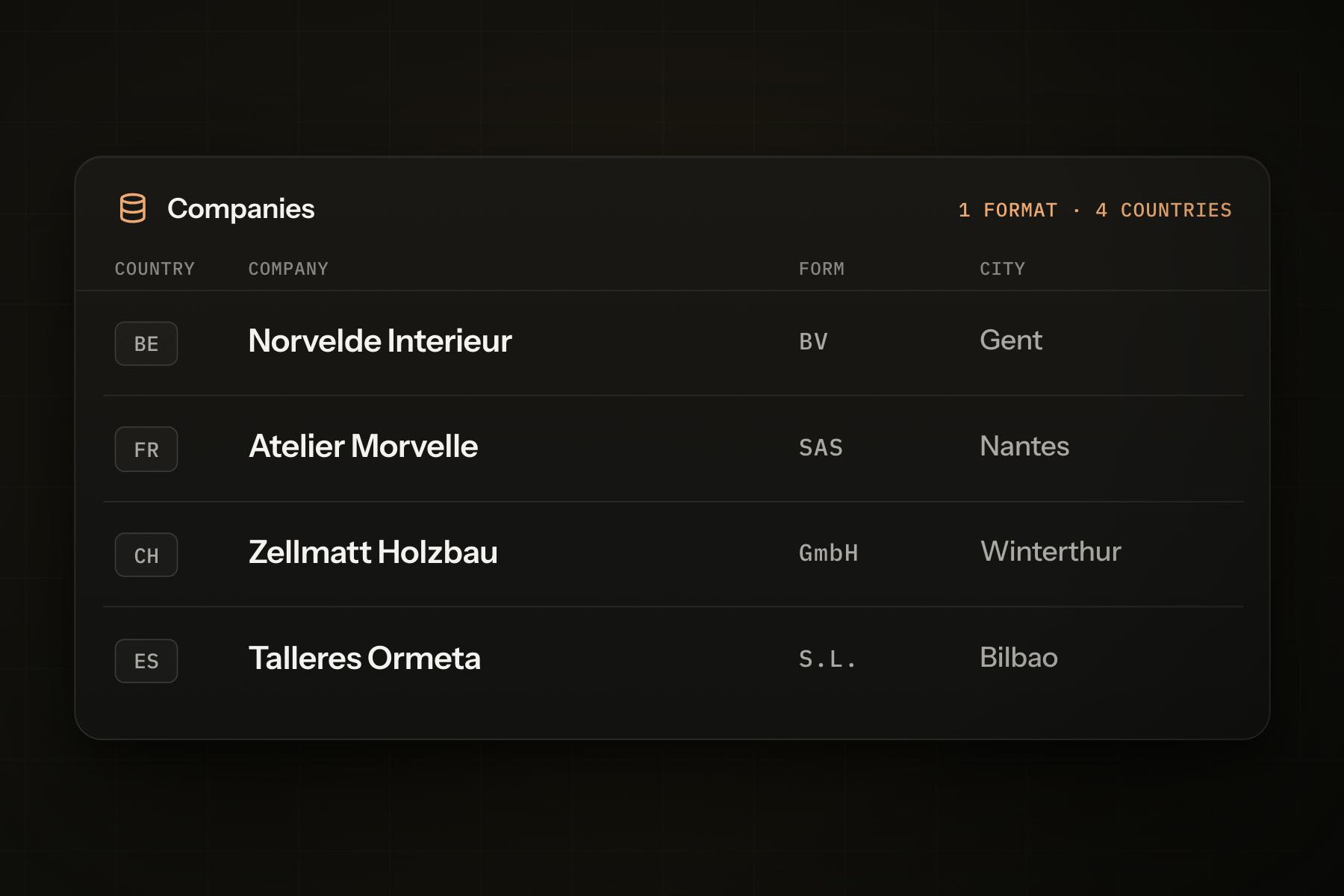
Each register has its own labels and language. The tool brings everything into one format, whatever the country.
- One format for all four countries
- The country of origin stays on every row
- Every legal form in its place: BV, SAS, GmbH, S.L.
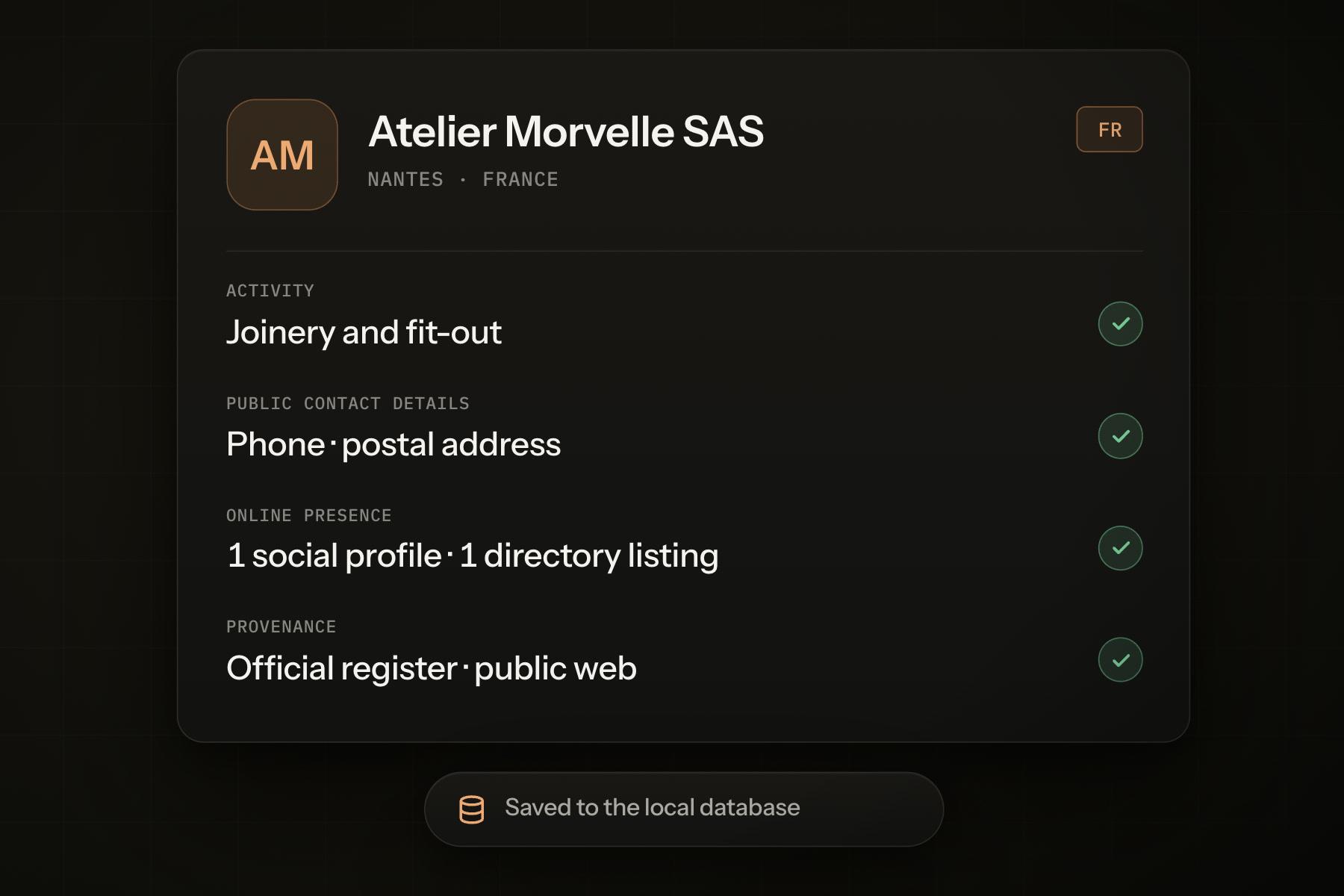
It completes each record: activity, public contact details and online presence, saved in its local database.
- What the company does
- Its public contact details
- Its online presence
- The record is saved in the local database
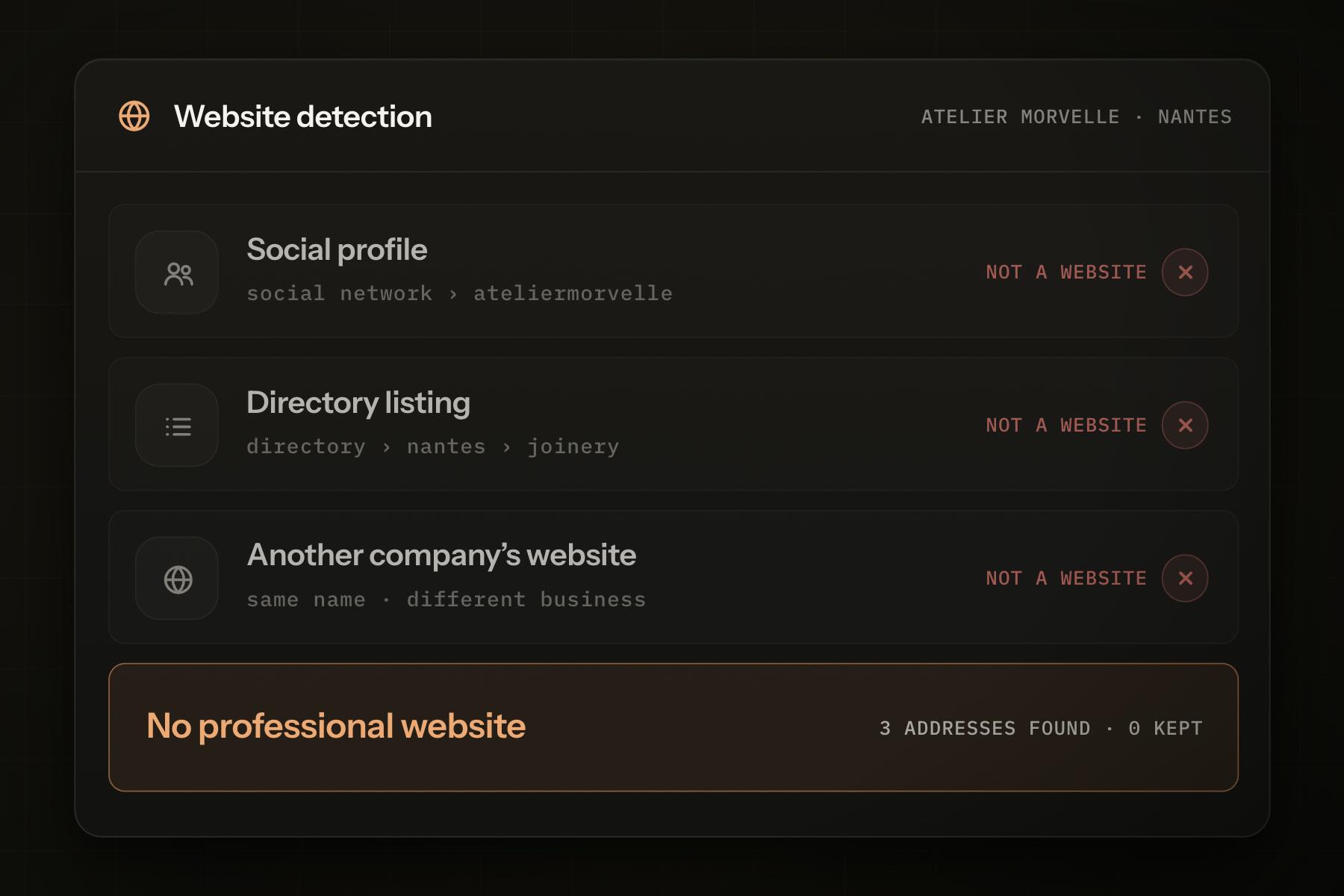
An address found is not necessarily a website: a social profile, a directory listing or another company’s site doesn’t count.
- A social profile is not a website
- Neither is a directory listing
- Nor is another company’s website
- The verdict: a professional website, or not
Each company is qualified, and the ones that aren’t relevant are set aside.
- The qualification criteria
- Relevant: it is kept
- Set aside, with the reason
- The tally
Everything is centralised in a single dashboard, running locally on my PC.
- The tool runs locally, on my PC
- Companies, without a website, to contact: the three counters
- The split by country
- The companies to contact
All that’s left for me is a personalised approach, based on what I can offer: a website, an automation, a dashboard or an iOS app.
- What the tool found
- My four services
- The approach to prepare
01 / 07
01 / 07
Collect
ProspectAtlas starts from official company registers, one source per country, and keeps the provenance of every field.
- Four countries: Belgium, France, Switzerland, Spain
- One official register per country
- The provenance of every field is kept
02 / 07
Normalise
Each register has its own labels and language. The tool brings everything into one format, whatever the country.
- One format for all four countries
- The country of origin stays on every row
- Every legal form in its place: BV, SAS, GmbH, S.L.
03 / 07
Enrich
It completes each record: activity, public contact details and online presence, saved in its local database.
- What the company does
- Its public contact details
- Its online presence
- The record is saved in the local database
04 / 07
Check the website
An address found is not necessarily a website: a social profile, a directory listing or another company’s site doesn’t count.
- A social profile is not a website
- Neither is a directory listing
- Nor is another company’s website
- The verdict: a professional website, or not
05 / 07
Qualify
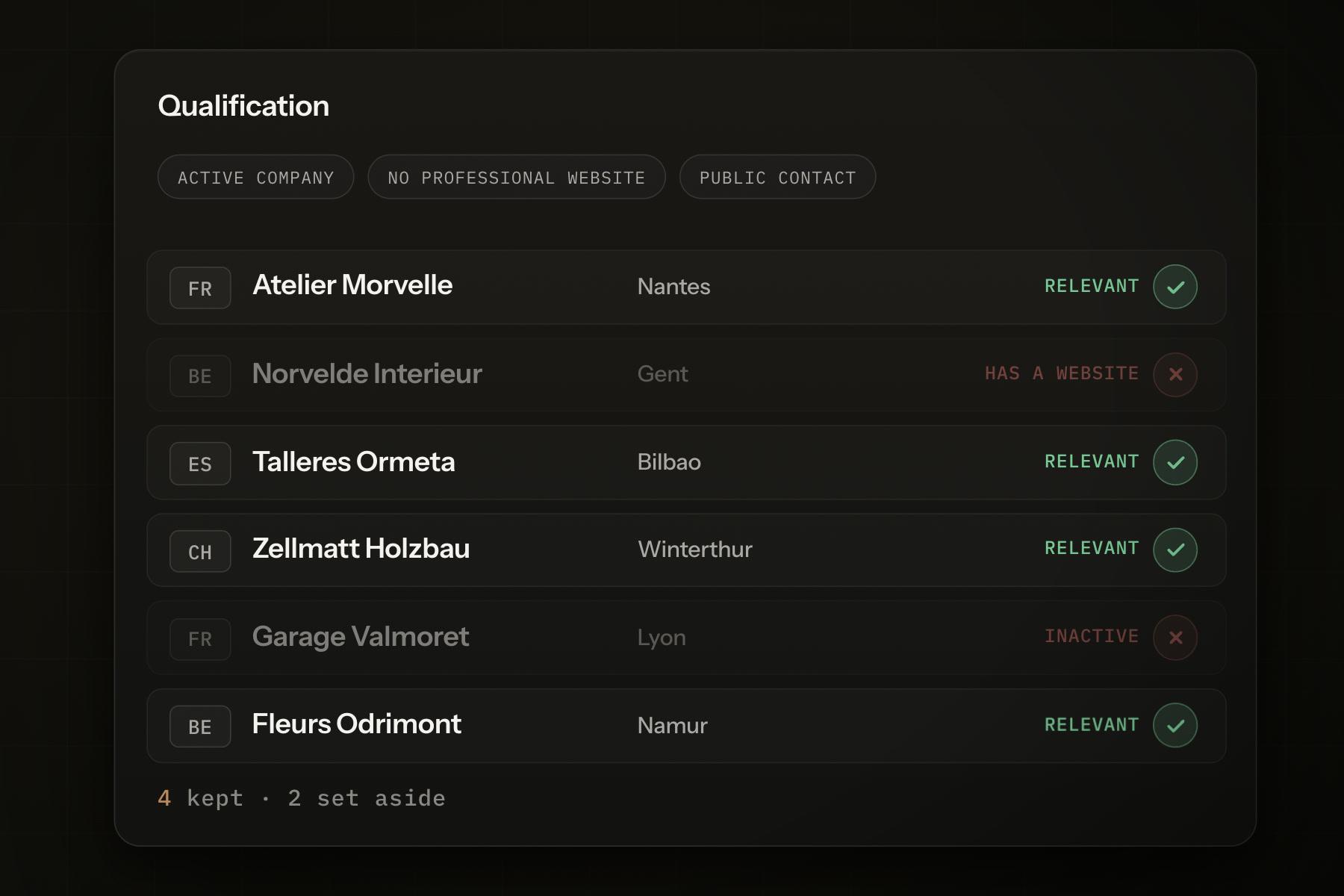
Each company is qualified, and the ones that aren’t relevant are set aside.
- The qualification criteria
- Relevant: it is kept
- Set aside, with the reason
- The tally
06 / 07
The dashboard
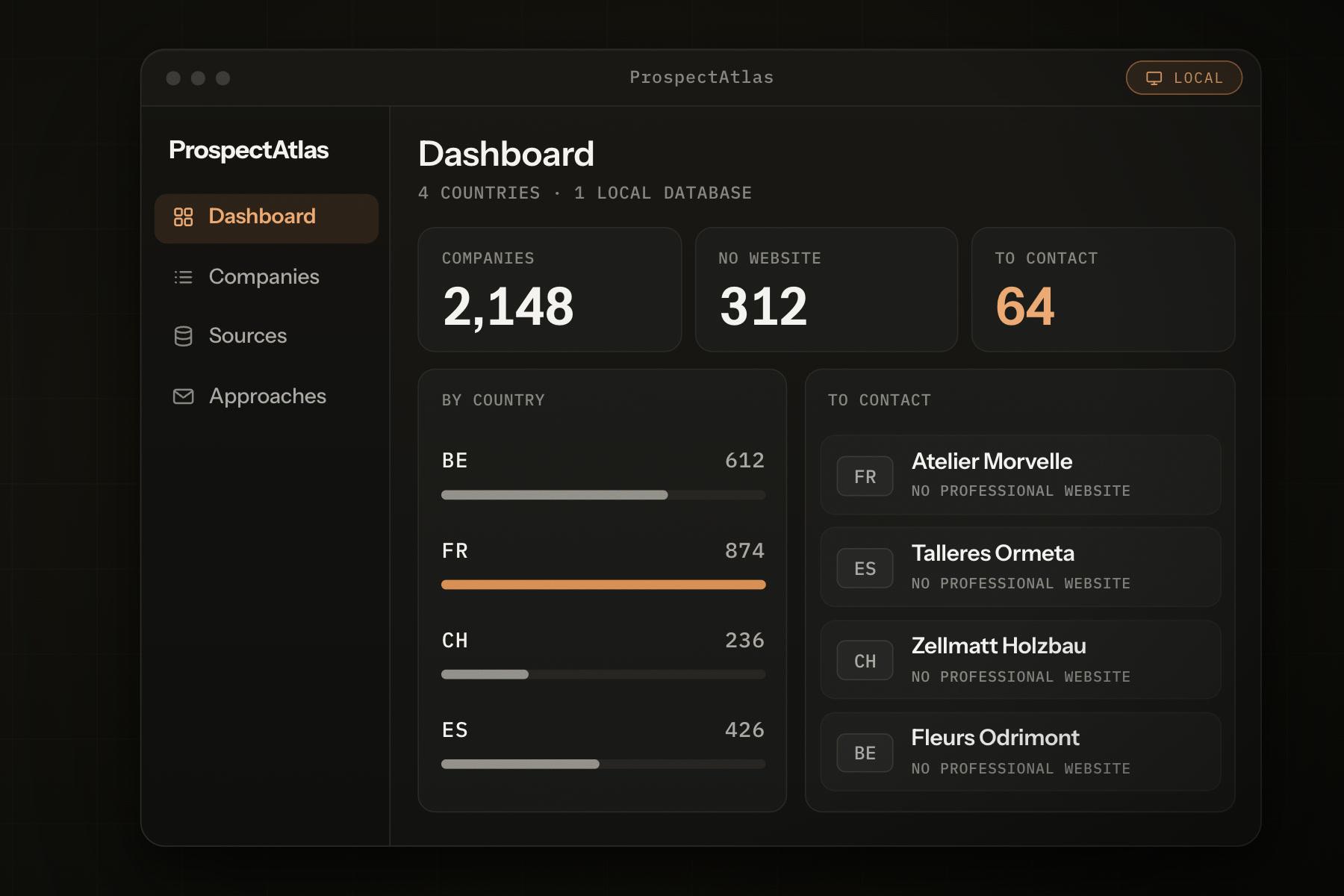
Everything is centralised in a single dashboard, running locally on my PC.
- The tool runs locally, on my PC
- Companies, without a website, to contact: the three counters
- The split by country
- The companies to contact
07 / 07
Approach
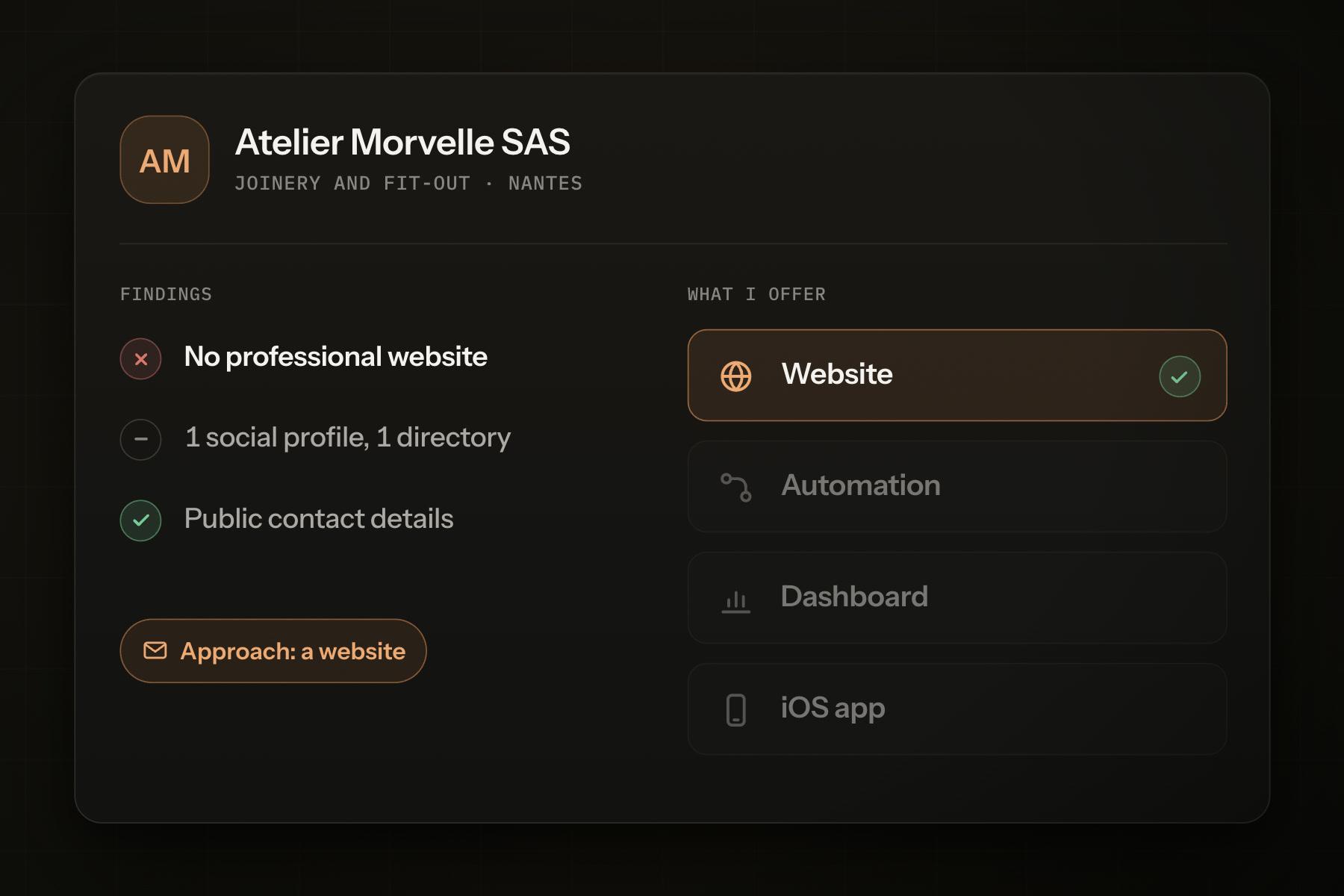
All that’s left for me is a personalised approach, based on what I can offer: a website, an automation, a dashboard or an iOS app.
- What the tool found
- My four services
- The approach to prepare
01 / 07
Under the hood
- Python
- FastAPI
- SQLAlchemy
- SQLite
- Jinja2
- httpx
- Beautiful Soup
- APScheduler
- Ollama
- Docker
Four countries, one format
Belgium, France, Switzerland, Spain: every official register is brought into the same data structure.
A real website, or not
A social profile, a directory listing or another company’s site doesn’t count as a professional website.
Local, for my own business
The tool runs on my PC and helps me offer my services: websites, automations, dashboards, iOS apps.
The full case study
My role
A personal project designed and built end to end: concept, functional architecture, collection and processing logic, enrichment workflows, prospect qualification, user experience, development, and the move to a multi-country architecture.
The problem
To offer my services, I first have to find the companies they could help. By hand, that means hours of repetitive research: locate the company, check what it does, look for its online presence, work out whether it already has a site, find public contact details, and discard the irrelevant ones.
The solution
A prospecting tool built for my own business: websites, workflows and automations, process optimisation, dashboards, iOS apps. It starts from the official company registers of four countries (Belgium, France, Switzerland, Spain) and runs through normalisation, enrichment, website detection, contact discovery and qualification, to preparing a personalised approach. Everything is centralised in one dashboard and the tool runs locally, on my PC. Belgium relies on BCE/KBO data, France on SIRENE.
What was hard
Reconciling sources that contradict each other, use different taxonomies and are not equally current — while keeping every field traceable to where it came from.
Detecting whether a company genuinely has a professional website: a URL found can be a social profile, a directory listing, a generic page, or another company entirely.
Absorbing hundreds of thousands of records without blocking the application, which forces heavy batch processing to be separated from the deep enrichment of a single company.
Keeping one architecture while each country brings its own registries, formats, activity codes and languages.
The outcome
Commercial research that used to be a scatter of manual steps becomes one structured, centralised workflow: consolidated data, no repeated lookups, stricter qualification and traceable sources.