- Automation
Job Application AssistantATS-ready CV and cover letter, with Claude
I paste a job offer: it scores it out of 100, then writes an ATS-ready CV and a tailored cover letter from my real background.

Launch film · English voice-over and captions · 1:06
The film, in text
Applying properly means rewriting your CV and your cover letter for every single offer.
And before that, guessing whether the offer is really worth it.
So I built a job application assistant on Claude that does all of it, without ever inventing a thing.
First, it gets to know the candidate: CV, LinkedIn, degrees, then questions, block by block, until nothing is left to guess.
After that, all it takes is pasting a job: the link, or the whole description.
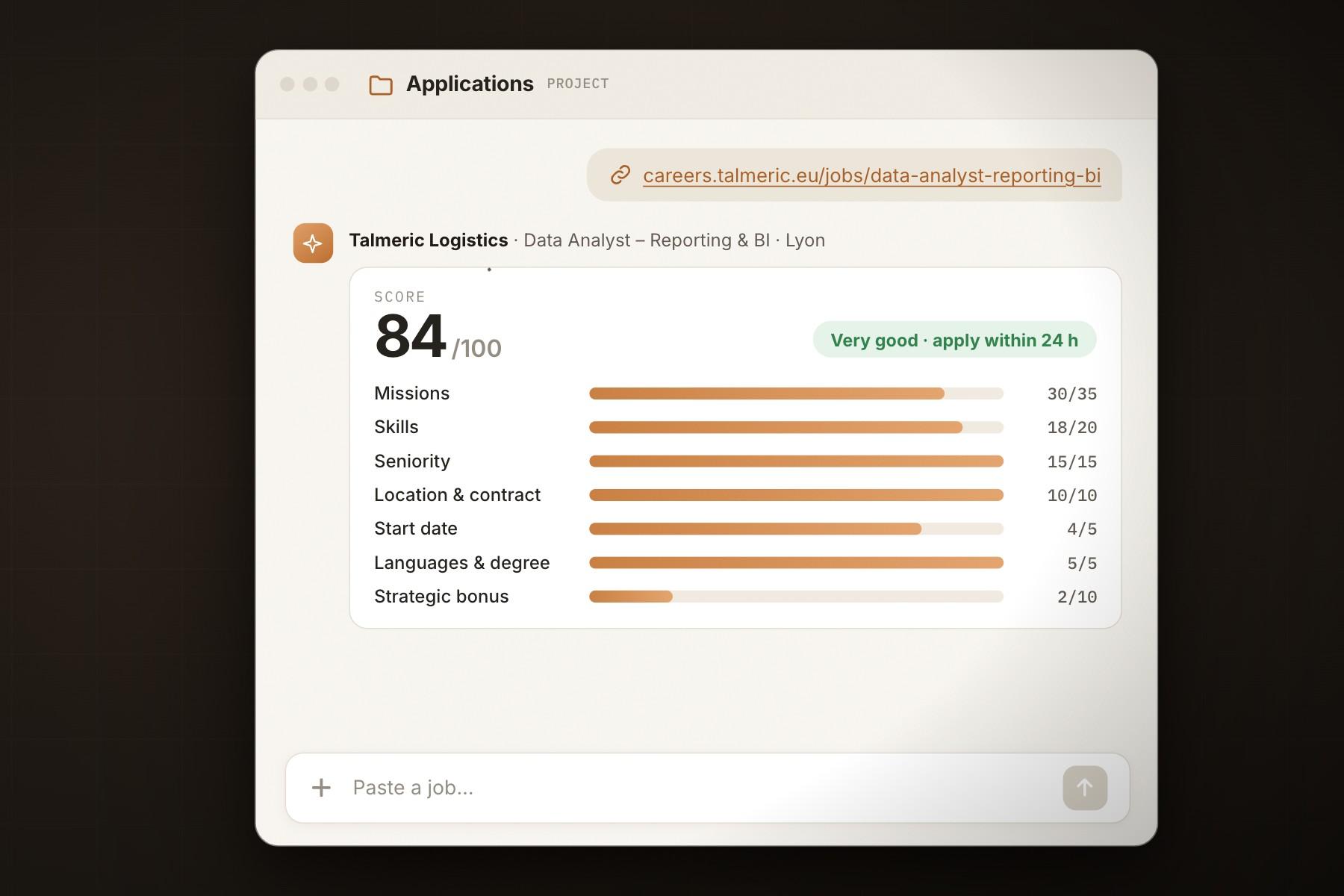
It scores it out of a hundred on seven criteria: missions, skills, seniority, location and contract, start date, languages, and a strategic bonus.
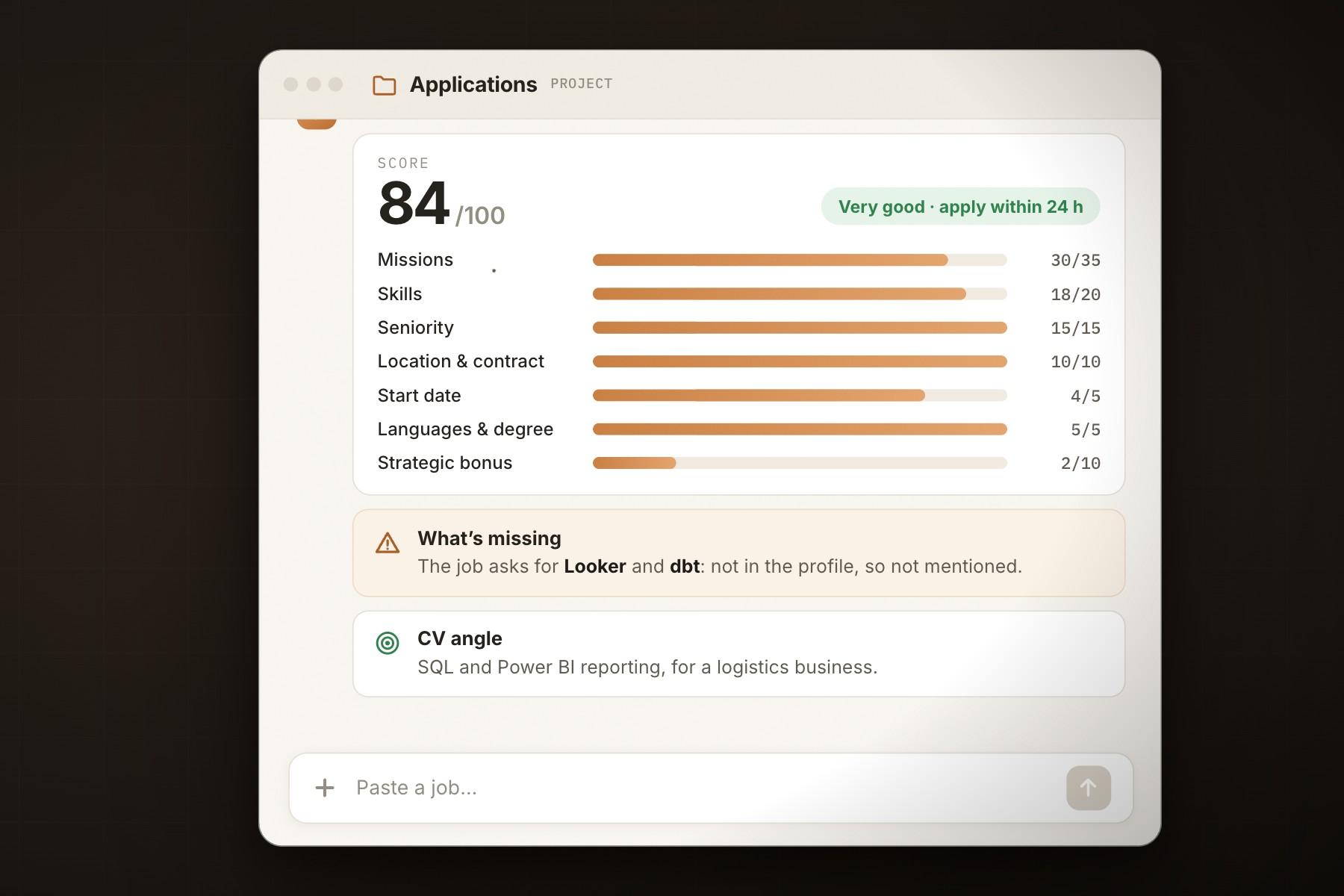
It says honestly what’s missing, and which angle it will take.
Then it writes the CV: one page, ATS-friendly, in the job’s language, with its keywords, but only what’s true.
And the cover letter: one page, three paragraphs, written for that company.
Every line is checked against the profile, and nothing goes out without a yes.
I built it for myself first. Now my friends install it in five minutes. Paste a job, get an application.
At a glance
- points, spread over seven criteria
- 100
- for the CV as for the cover letter
- 1 page
- lines without proof in the profile
- 0
- to install it, with the guide
- 5 min
The tool, step by step
8 steps, each on one of the tool’s screens. Interface rebuilt for the film, with invented companies and figures.
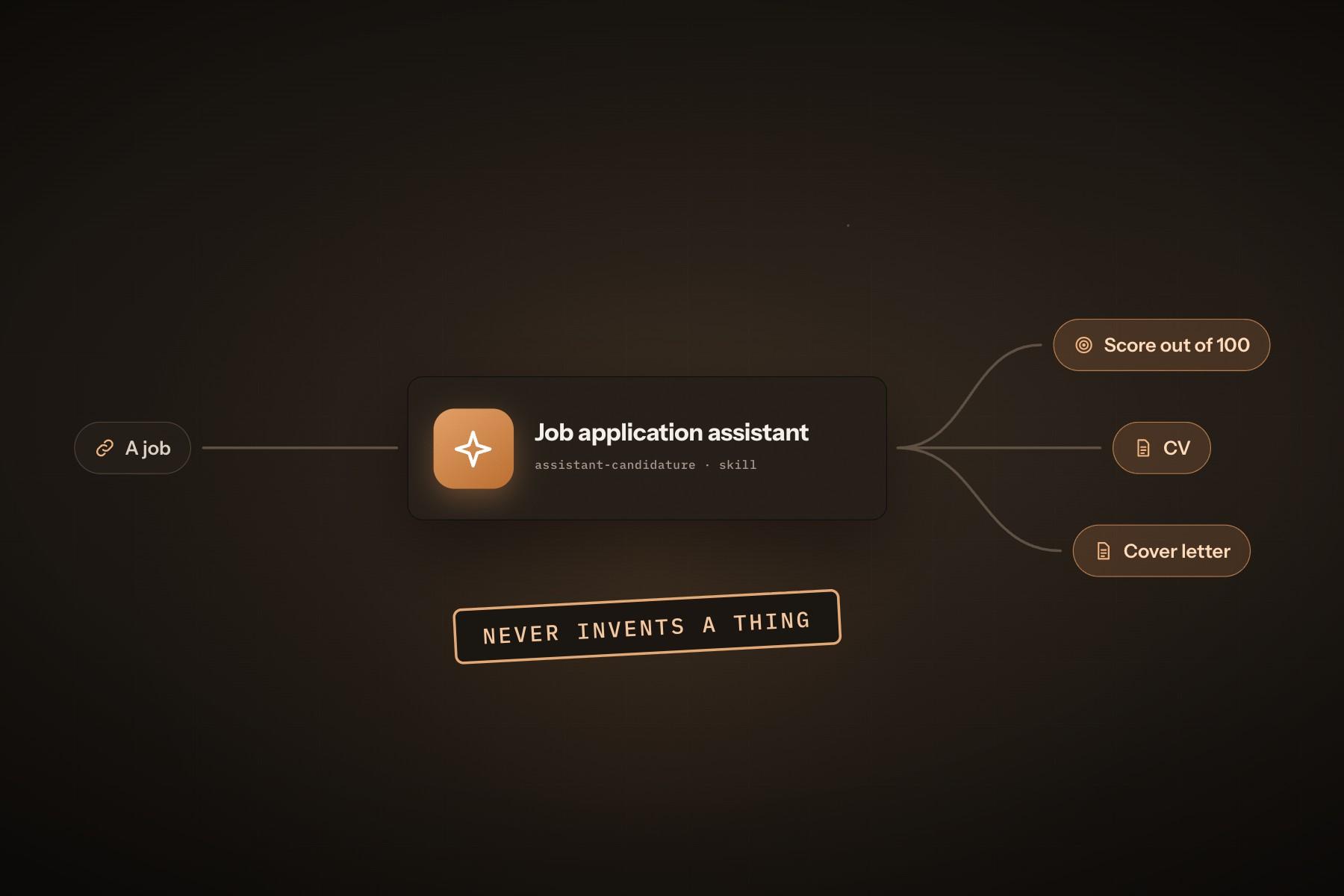
A skill for Claude: a job offer goes in, a score, a CV and a cover letter come out.
- A job: a link, the text, a screenshot or a PDF
- A skill, imported into Claude once
- Three deliverables: the score, the CV, the letter
- Its first rule: never invent anything
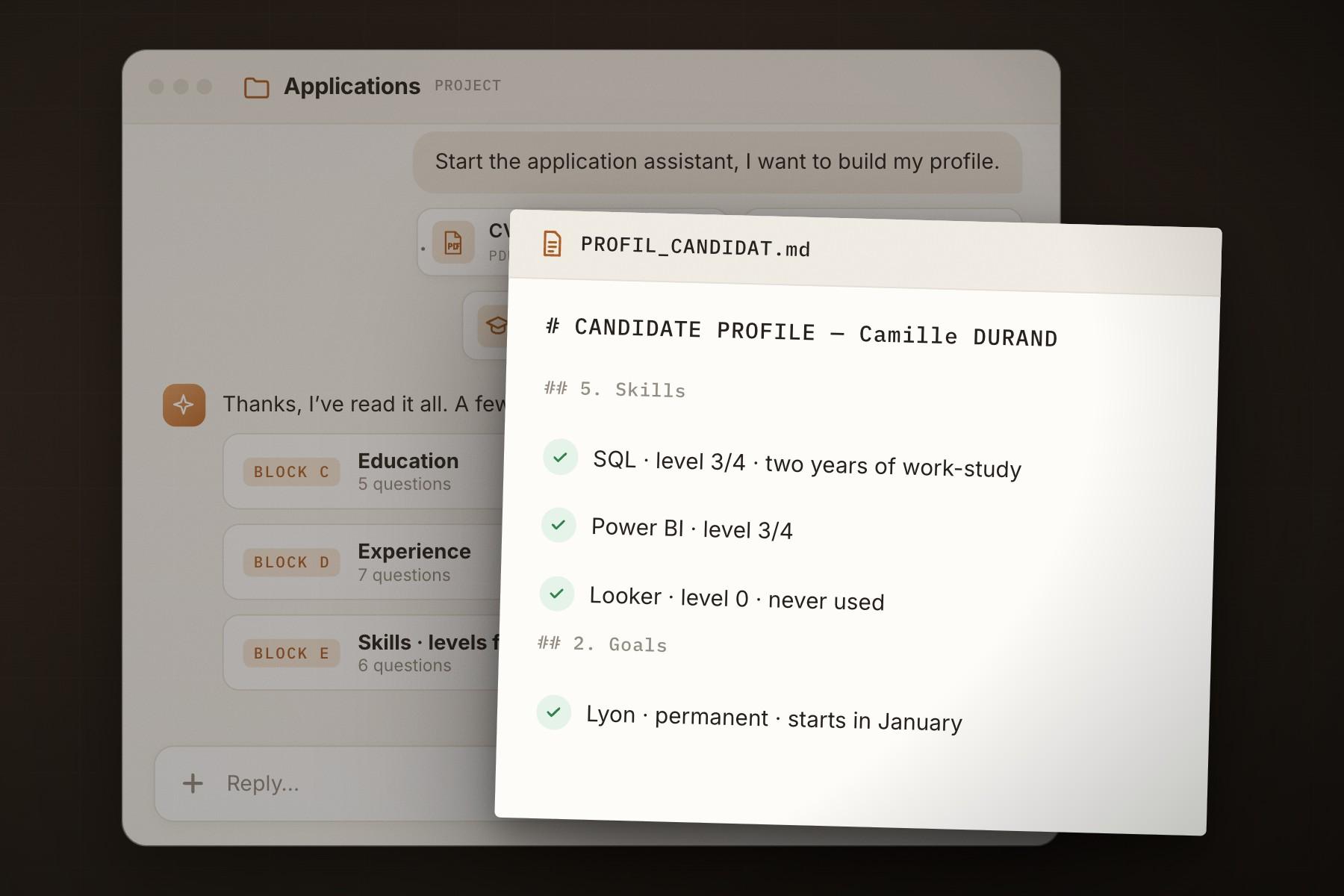
Once, the assistant gets to know the candidate, then files it all in one file the candidate reviews.
- Documents first: CV, LinkedIn, degrees, dream jobs
- Then only the missing questions, in blocks of 5 to 8
- Each skill rated 0 to 4, with where and since when
- It all fits in one file, reviewed by the candidate
Paste the job’s link or text: it is scored out of 100, on seven criteria with fixed weights.
- The link, or the job’s whole text
- The score out of 100
- Five categories: from 70 to 84, apply within 24 h
- Seven criteria, from missions out of 35 to a bonus out of 10
Before writing, the assistant says plainly what the candidate lacks for this job, and what it will put forward.
- Below 55, it explains and asks before writing
- What the job asks for and the profile lacks
- The CV’s angle, chosen for this job
One ATS-ready page, in the job’s language, with its keywords when they are true.
- The job’s own words, when the profile proves them
- One column, no tables, logos or level bars
- Absent from the profile, Looker and dbt stay out
One page, three paragraphs, written for that company, with no invented motivation.
- The company and the role, copied from the job
- Three paragraphs: the role, the proof, what I bring
- One page, as a PDF, in the job’s language
Every line is checked against the profile. Both PDFs are delivered, and the candidate sends them.
- Every line has its proof in the profile
- Two one-page PDFs, in one folder per job
- Nothing is sent without a yes
My friends install it with a five-minute guide, then each builds their own profile.
- The whole skill fits in one .zip
- Each installs it on their own, with their profile
- Five minutes, with the guide
- Three steps, and the profile is built once
01 / 08
01 / 08
The assistant
A skill for Claude: a job offer goes in, a score, a CV and a cover letter come out.
- A job: a link, the text, a screenshot or a PDF
- A skill, imported into Claude once
- Three deliverables: the score, the CV, the letter
- Its first rule: never invent anything
02 / 08
The profile
Once, the assistant gets to know the candidate, then files it all in one file the candidate reviews.
- Documents first: CV, LinkedIn, degrees, dream jobs
- Then only the missing questions, in blocks of 5 to 8
- Each skill rated 0 to 4, with where and since when
- It all fits in one file, reviewed by the candidate
03 / 08
The score out of 100
Paste the job’s link or text: it is scored out of 100, on seven criteria with fixed weights.
- The link, or the job’s whole text
- The score out of 100
- Five categories: from 70 to 84, apply within 24 h
- Seven criteria, from missions out of 35 to a bonus out of 10
04 / 08
What’s missing
Before writing, the assistant says plainly what the candidate lacks for this job, and what it will put forward.
- Below 55, it explains and asks before writing
- What the job asks for and the profile lacks
- The CV’s angle, chosen for this job
05 / 08
The CV
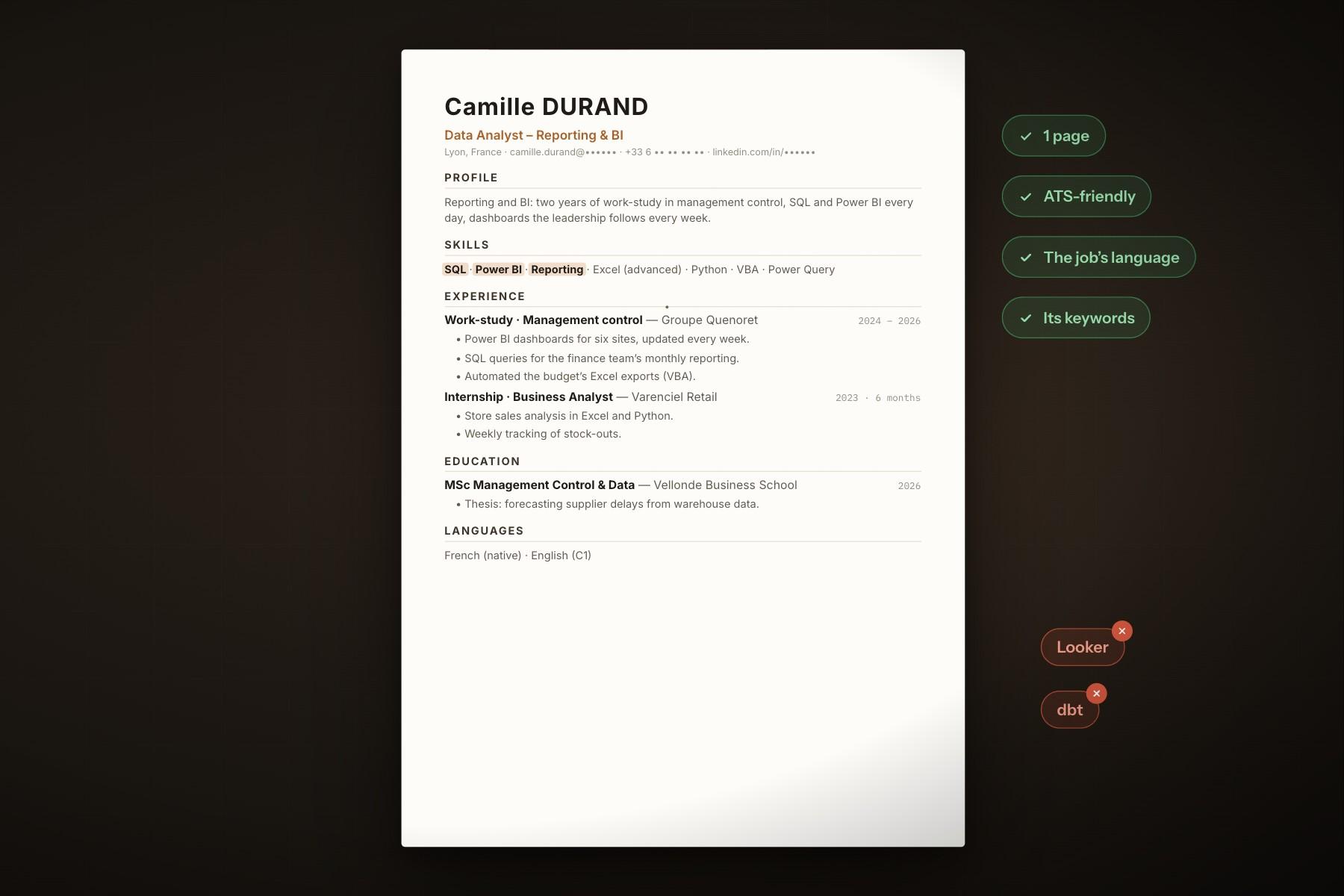
One ATS-ready page, in the job’s language, with its keywords when they are true.
- The job’s own words, when the profile proves them
- One column, no tables, logos or level bars
- Absent from the profile, Looker and dbt stay out
06 / 08
The cover letter
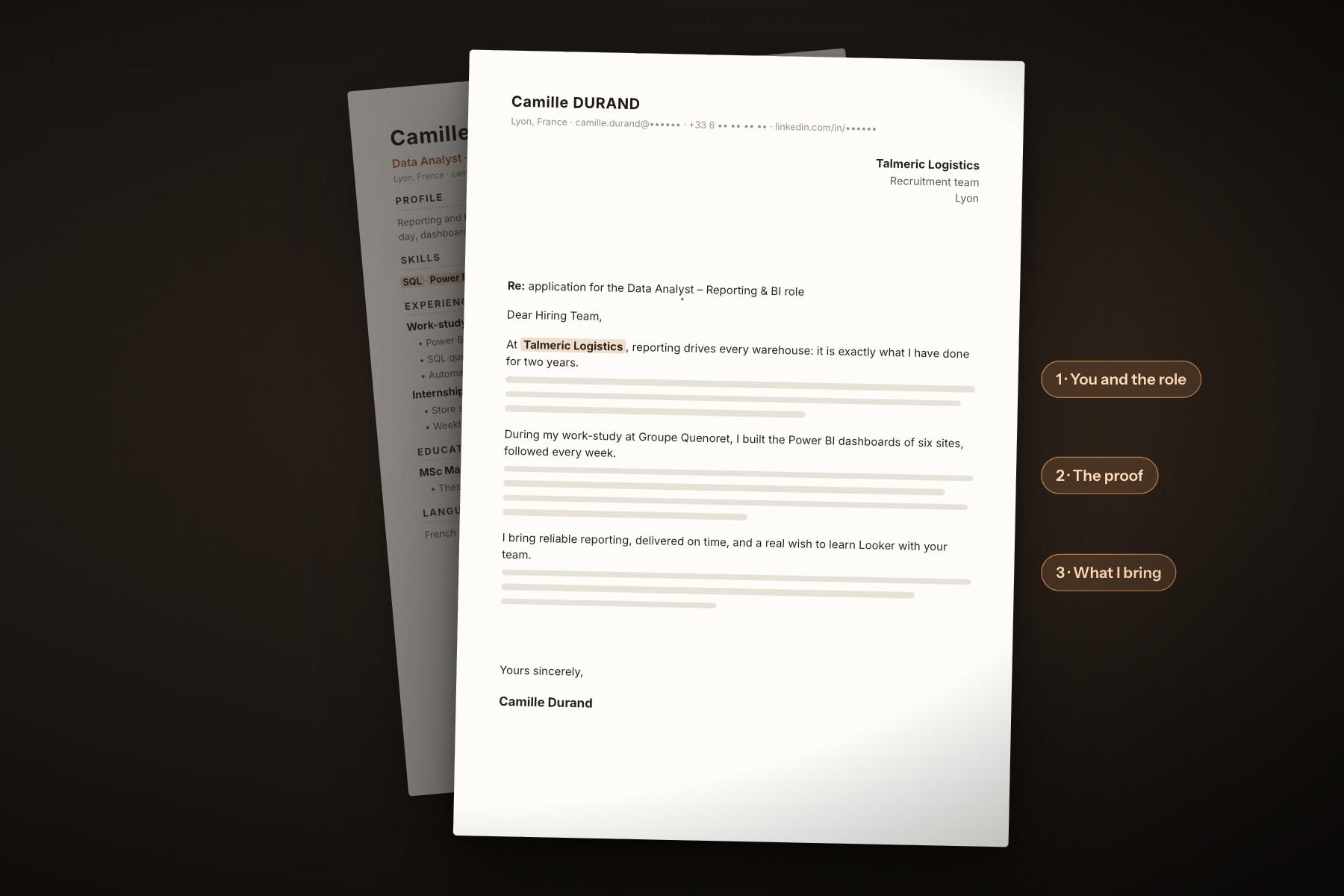
One page, three paragraphs, written for that company, with no invented motivation.
- The company and the role, copied from the job
- Three paragraphs: the role, the proof, what I bring
- One page, as a PDF, in the job’s language
07 / 08
Checked, then delivered
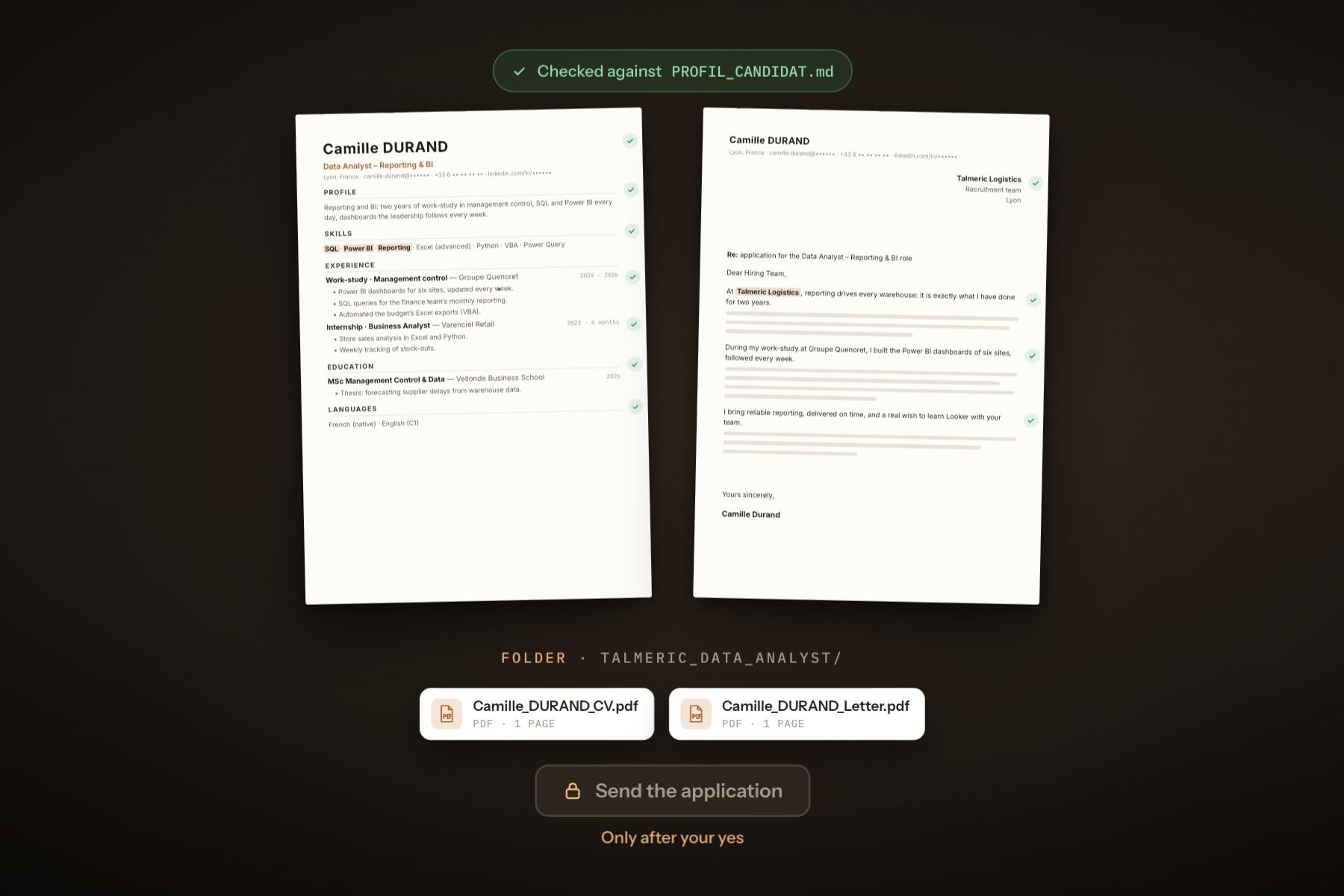
Every line is checked against the profile. Both PDFs are delivered, and the candidate sends them.
- Every line has its proof in the profile
- Two one-page PDFs, in one folder per job
- Nothing is sent without a yes
08 / 08
Installing it
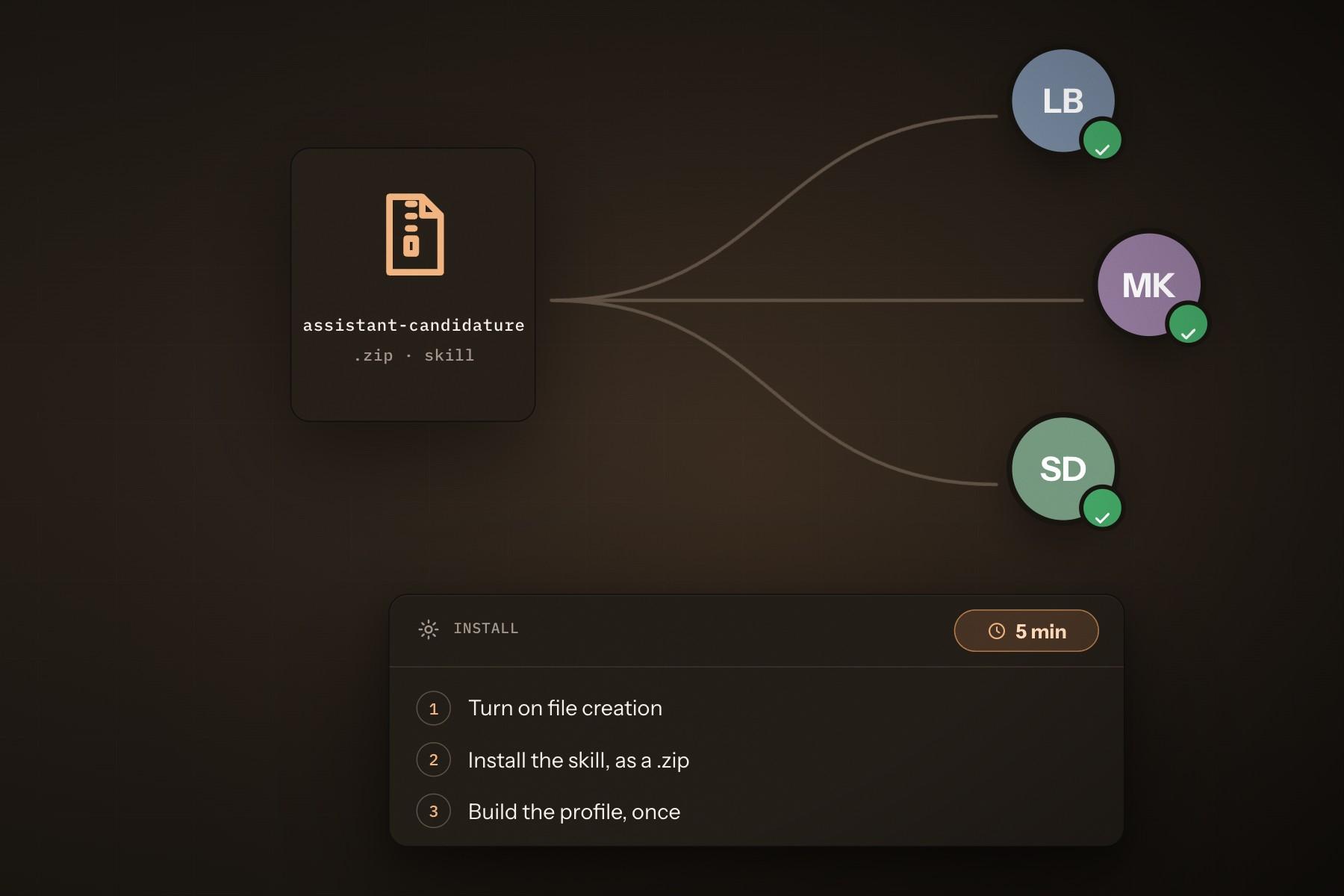
My friends install it with a five-minute guide, then each builds their own profile.
- The whole skill fits in one .zip
- Each installs it on their own, with their profile
- Five minutes, with the guide
- Three steps, and the profile is built once
01 / 08
Under the hood
- Claude
- Agent Skills
- Python
- ReportLab
- Markdown
Nothing invented
Each requirement of the job looks for its proof in the profile. Without proof, it goes into neither the CV nor the letter.
A score before writing
Seven weighted criteria say whether the job is worth it, what is missing, and from which angle to apply.
Made to be shared
A .zip and a five-minute guide: my friends install it and each build their own profile.
The full case study
My role
A personal project designed end to end: the assistant’s rules, the questionnaire that builds the profile, the scoring grid, the writing rules, the two scripts that make the PDFs, the install guide and the presentation film.
The problem
Applying properly means rewriting your CV and your cover letter for every offer, with the posting’s own words, on a page that applicant tracking software can read. And before that, deciding whether the offer is worth it. By hand, each application takes hours, and it is tempting to dress up what you cannot really do.
The solution
A skill for Claude, installed once. It starts by getting to know the candidate: their CV, LinkedIn profile, degrees and two or three dream offers, then only the questions still missing, in blocks of five to eight. Every skill gets a level from 0 to 4, with where and since when. It all fits in one file, PROFIL_CANDIDAT.md, which the candidate reviews. After that, all it takes is pasting an offer, its link or its whole text. The assistant scores it out of 100 on seven weighted criteria, says what is missing and the angle it will take, then writes the CV, one ATS-ready page in the offer’s language, and the cover letter, one page in three paragraphs. Two Python scripts turn them into PDFs. Every line is checked against the profile, and nothing is sent without a yes.
What was hard
Never inventing anything: no experience, skill, figure or motivation. Each requirement of the offer is matched with proof from the profile; without proof, the keyword stays out. A line that cannot be traced to the profile leaves the CV.
A score that helps decide: seven criteria with fixed weights, from missions out of 35 to a strategic bonus out of 10, and five categories, from “skip” to “apply right away”. Below the profile’s threshold, 55 by default, the assistant explains and asks before writing.
A CV that tracking software can read: one column, no tables, logos or level bars. The scripts shrink the text slightly to fit one page, and refuse when it is too long. The PDF is then turned into an image and looked at before delivery.
Making it shareable: a .zip to import into Claude and a five-minute guide. Since Claude cannot change its own skill, the profile is kept alongside it, in a Claude project or in an all-in-one version of the skill.
The outcome
I paste an offer and get, in the same conversation, its score, a CV and a cover letter ready to review. I built it for myself first; now my friends install it too, each with their own profile.