- Website
2G BusinessA bilingual Next.js portfolio
The site you are reading: my portfolio, in French and in English, where every project is shown on film and screen by screen rather than in text.

Launch film · English voice-over and captions · 0:27
The film, in text
This site is my portfolio, and a project in its own right.
I designed and built it myself, in French and in English.
Every project is shown, not described: a film first, then its screens, step by step.
My journey is drawn city by city, on a globe.
Every page reads as well on a phone as on a computer,
and tracks no one.
And every decision is written down, beside the code.
At a glance
- languages, from the text to the films
- 2
- projects, each on film and screen by screen
- 10
- trackers, ads or third-party services
- 0
- decisions written down beside the code
- 30+
The site, page by page
7 views of the site, each with what it shows. Screenshots of the site itself, as it is online.
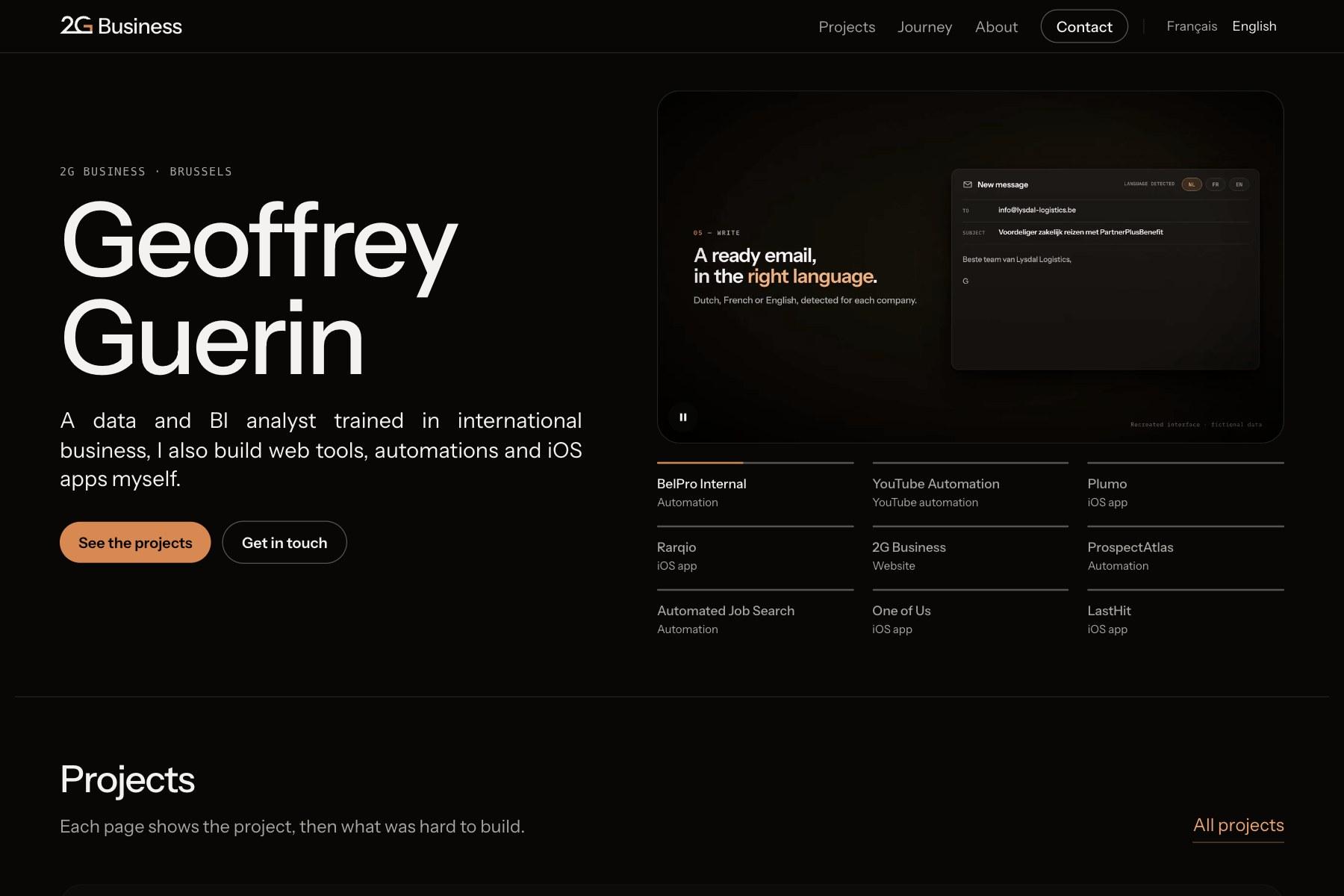
On the left, who I am in one sentence, and two buttons. On the right, the projects take turns, each with its film.
- Who I am, in one sentence
- The projects or a way to reach me, one click away
- The projects take turns, each with its film
- Click a name to see its film
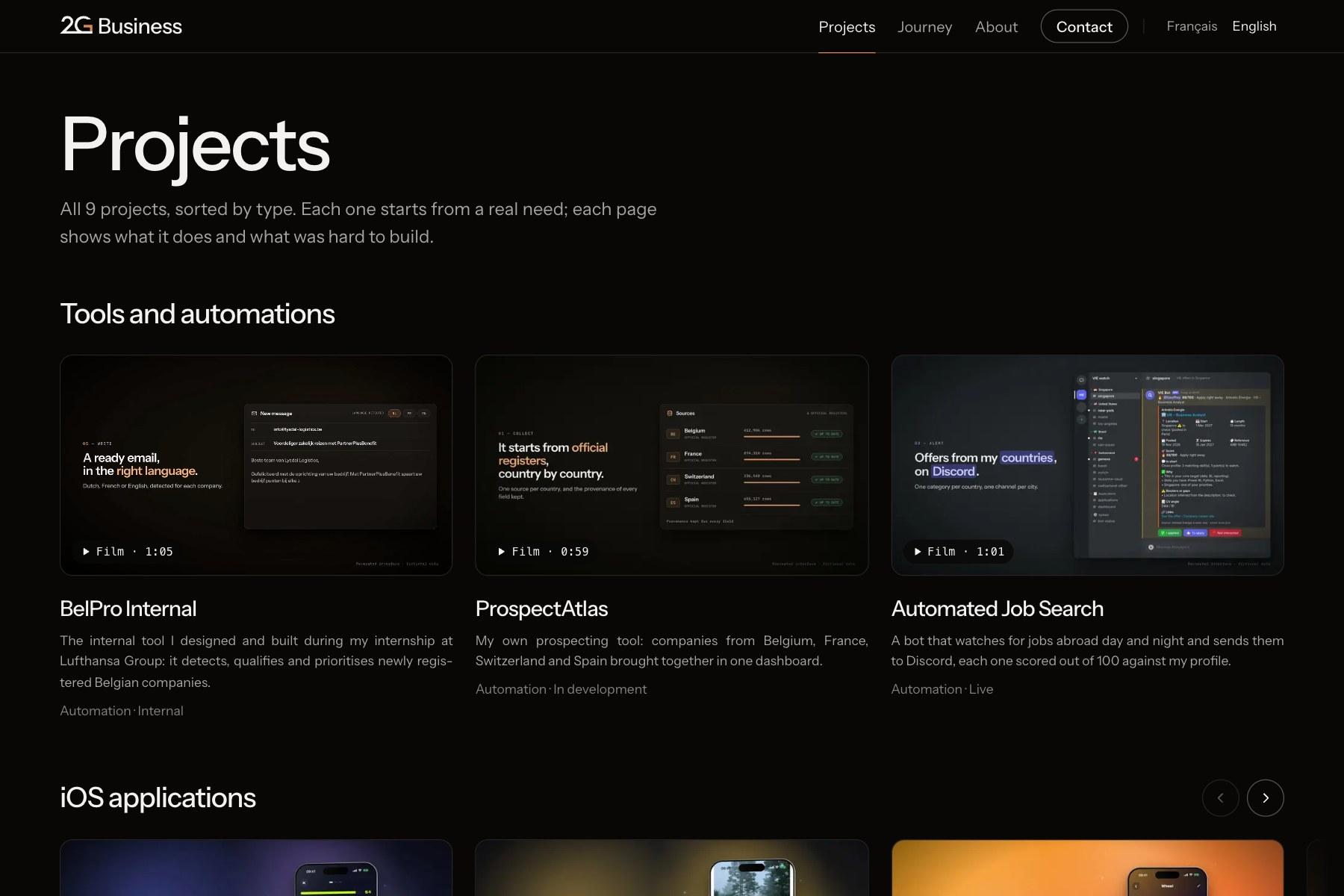
Every project on one page, sorted by kind. The films play in turn, so the page never moves all at once.
- Every project on one page
- Sorted by kind: tools, apps, YouTube, websites
- Each card plays its film, in turn
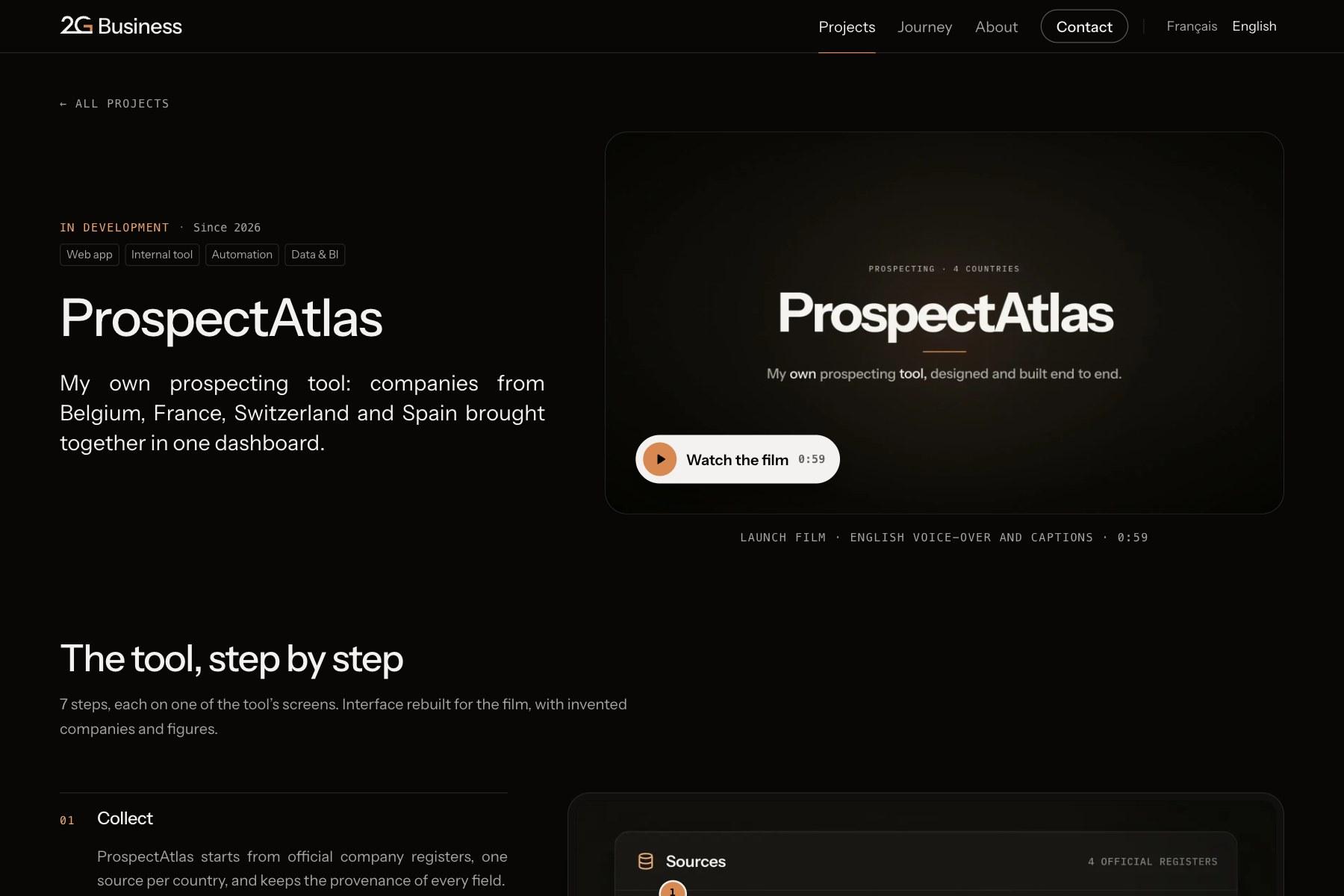
Every project page opens on the project’s film, then its key figures, its screens and what was hard to build. Here, ProspectAtlas.
- The film first, in French or in English
- What the project does, in one sentence
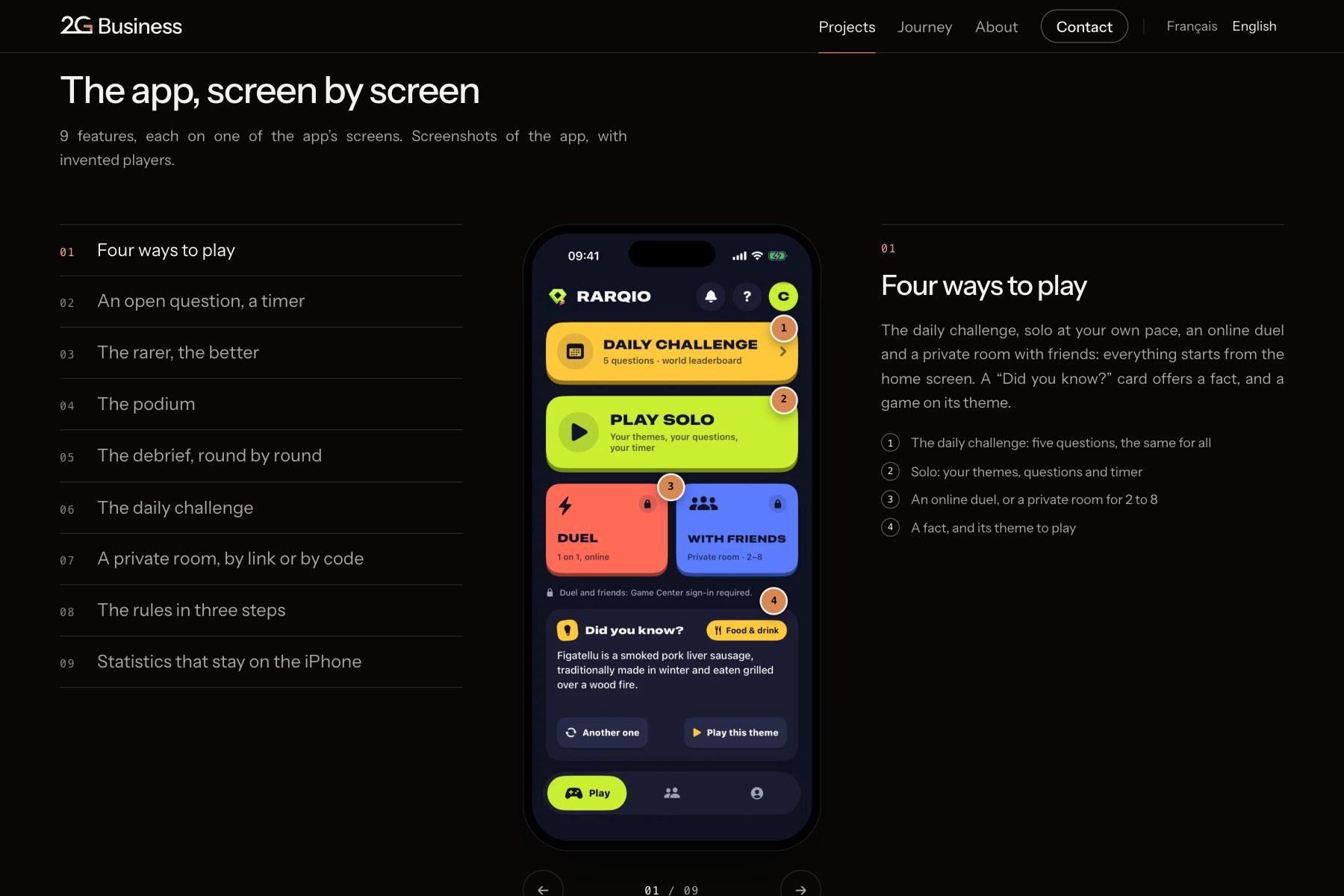
A project’s tour, step by step: one screen, what it does and numbered points. Here, the Rarqio app.
- Each step on its own screen
- Numbered points on the screen
- Every step, at a glance
My studies and work on a globe that follows the reading, chapter by chapter. No 3D engine, and readable without script.
- The globe follows the reading, city by city
- From French Guiana to Brussels
On the home page, the route draws itself live, city to city, and the list lights up in step. Ten seconds, then it starts again.
- The route links the cities, on a loop
- The list lights up in step
- A button to stop it
Experience and education side by side, then the skills across the full width, data and BI first.
- Roles, with their dates
- The latest degrees
- The data and BI tools, first
- Languages
01 / 07
01 / 07
Home
On the left, who I am in one sentence, and two buttons. On the right, the projects take turns, each with its film.
- Who I am, in one sentence
- The projects or a way to reach me, one click away
- The projects take turns, each with its film
- Click a name to see its film
02 / 07
Projects
Every project on one page, sorted by kind. The films play in turn, so the page never moves all at once.
- Every project on one page
- Sorted by kind: tools, apps, YouTube, websites
- Each card plays its film, in turn
03 / 07
A project page
Every project page opens on the project’s film, then its key figures, its screens and what was hard to build. Here, ProspectAtlas.
- The film first, in French or in English
- What the project does, in one sentence
04 / 07
Screen by screen
A project’s tour, step by step: one screen, what it does and numbered points. Here, the Rarqio app.
- Each step on its own screen
- Numbered points on the screen
- Every step, at a glance
05 / 07
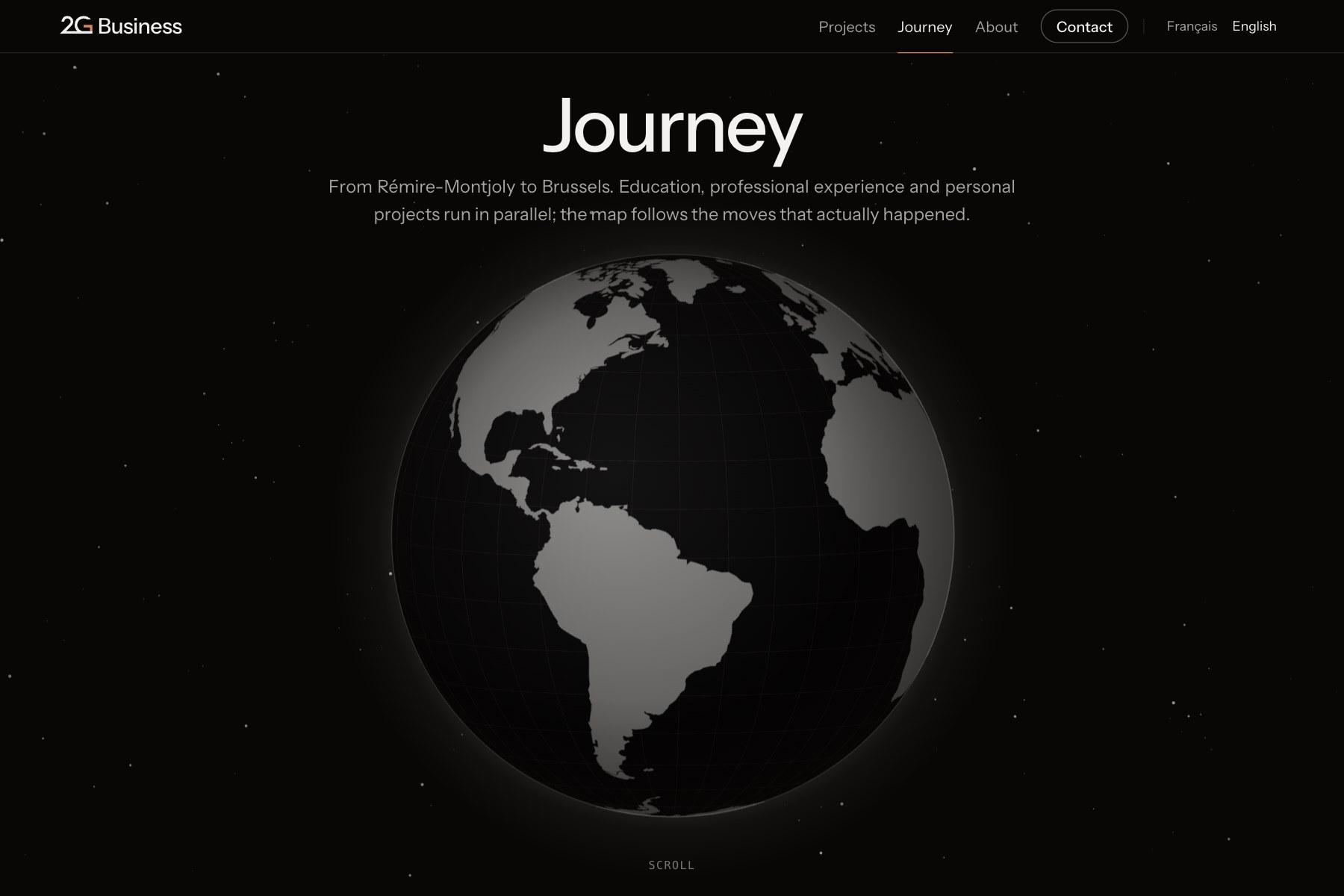
The journey
My studies and work on a globe that follows the reading, chapter by chapter. No 3D engine, and readable without script.
- The globe follows the reading, city by city
- From French Guiana to Brussels
06 / 07
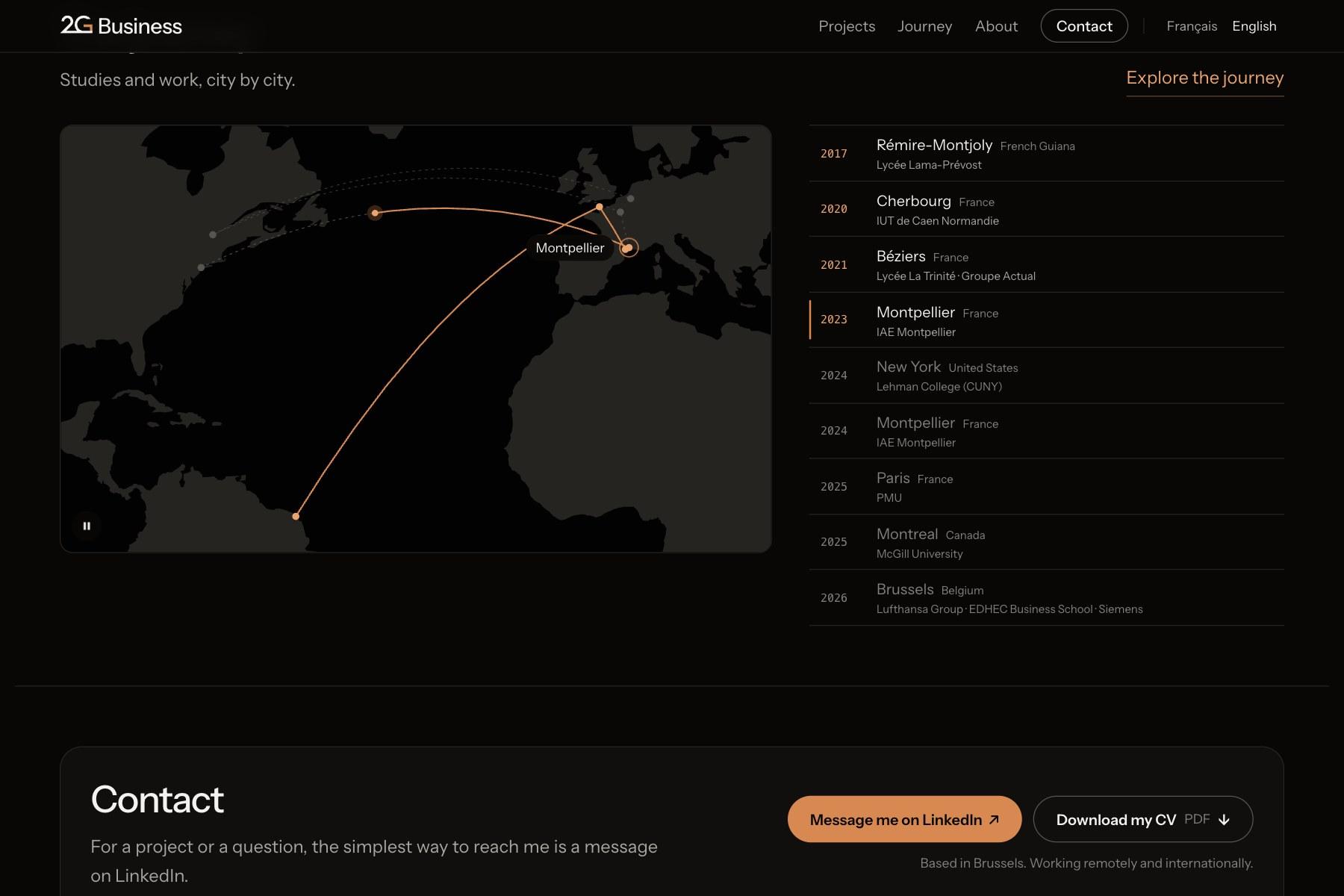
City by city
On the home page, the route draws itself live, city to city, and the list lights up in step. Ten seconds, then it starts again.
- The route links the cities, on a loop
- The list lights up in step
- A button to stop it
07 / 07
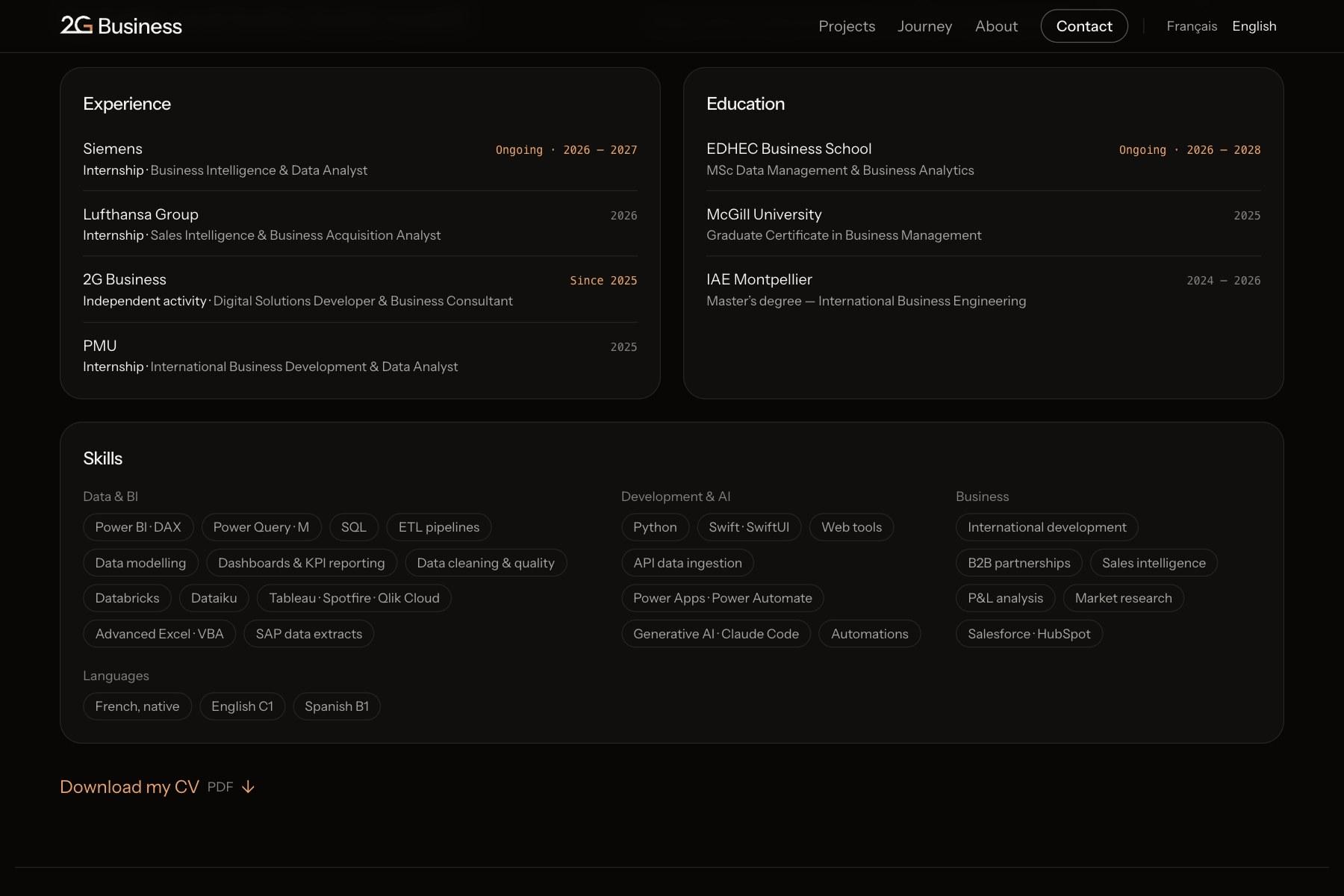
About
Experience and education side by side, then the skills across the full width, data and BI first.
- Roles, with their dates
- The latest degrees
- The data and BI tools, first
- Languages
01 / 07
Under the hood
- Next.js
- TypeScript
- Tailwind CSS
- next-intl
- d3-geo
- Vercel
Shown, not described
Every project has a narrated film, in French and in English, then its screens step by step. The films are made in code.
A globe without a 3D engine
The journey turns on a globe drawn in 2D, ten times lighter than a 3D library. The chapters stay real text.
Content that does not overstate
A role shows results only once the work is done, and a test keeps any unverified technology off the page.
The full case study
My role
Conceived and directed: positioning, information architecture, design system, bilingual content, security and performance. Every technical trade-off is recorded in the repository.
The problem
A portfolio has to be found, read and understood — by an applicant tracking system, a search engine, or someone on a phone in a corridor. Yet the sites that impress are often the ones that make their content unreachable: everything in a canvas, nothing in the text.
The solution
A bilingual, statically rendered site where every page exists as complete HTML before any script runs. The animated globe on the Journey is a decorative layer over chapters that are real DOM: the content reads without JavaScript, indexes, and can be walked by a screen reader.
What was hard
Holding an animated experience and genuinely indexable content in one page, rather than choosing one against the other.
Rendering the globe without WebGL: a 2D canvas costs 11 KB against 129 KB for a 3D library, and polishing it to its ceiling cost 1.7 more.
Stopping the content from overstating itself in the data rather than in review: a role that has not started cannot carry achievements, and an unverified technology is not displayed.
Hardening the response headers to the edge of what static rendering allows, and holding that edge with a test rather than an intention.
The outcome
A site whose every page is a complete HTML file served without a single third-party request, and whose technical decisions — including the rejected ones — are written beside the code they govern.